Un dibujo: Otro enfoque para aproximarse a la composición de melodía

Otra idea que propone Gonzalo Macías en su libro “Doce Maneras de Abordar la Composición” es comenzar haciendo un dibujo de la duración de las notas en una melodía.

Una línea larga puede significar una nota larga, y análogamente funciona para notas breves. Hicimos un ejemplo basado en el siguiente dibujo:

Del lado izquierdo aparecen líneas horizontales que representan la duración de cada nota. Las líneas verticales representan el pulso o beat. En este caso son cinco segundos. El dibujo de la derecha representa su equivalente en figuras rítmicas. Observe el lector o lectora el compás de 5/4 que se toca a una negra o cuarto cada segundo.

Dibujo y su equivalente en notas

Ese patrón rítmico se repite tres veces más haciendo variaciones en la tercera nota del compás. Finalmente se busca un cierre a la idea melódica. En el ejemplo que realizó quien escribe estas líneas dió como resultado esta partitura:

Obsérvese como los últimos compases cambian a 2/4 para ir aproximándose por quintas a un cierre del tema.

Es una idea simple, sin embargo sirva para probar las ideas de Macías sobre acercamientos a la composición. El resultado final aparece en este video y es la tercera de la serie “Miniaturas para Bajo”.
Miniatura para Bajo 3

“Hunting a Line 2” based on Macias´ work

This piece is a composition based on Gonzalo Macías’s book Doce Maneras de Abordar la Composición Musical.
https://www.scribd.com/document/720664690/Doce-maneras-de-abordar-la-composicio-n-musical-Gonzalo-Maci-as-1

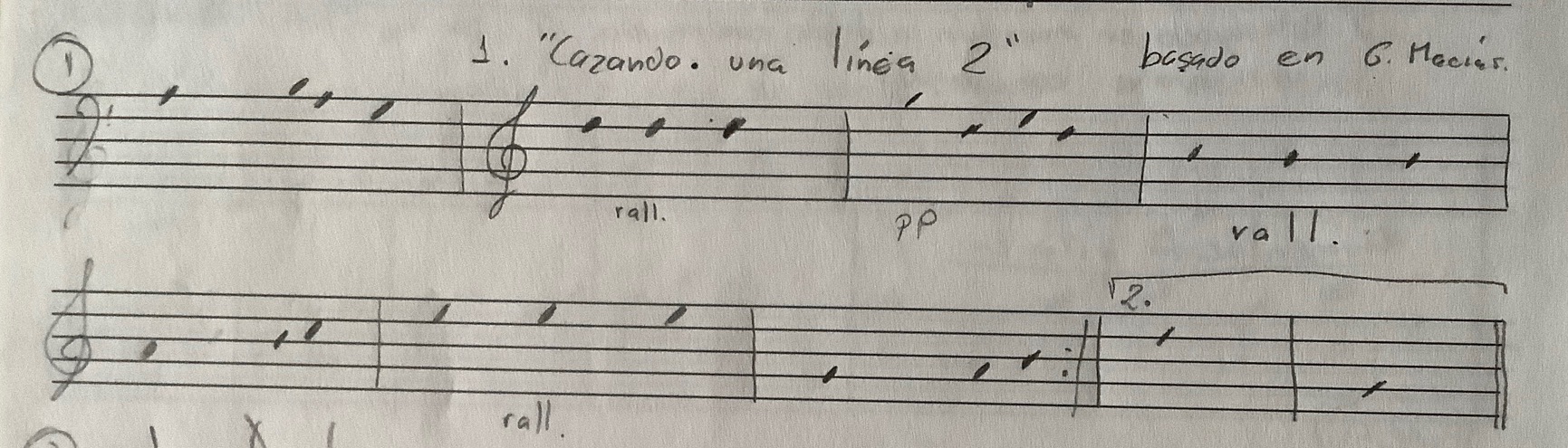
In his first exercise, titled “Cazando una Línea” (“Hunting a Line”), Macías proposes writing down the pitch of the notes on the staff without paying attention to their rhythm.

The purpose of this is to avoid getting distracted by thinking about rhythm and pulse, and instead to focus on the creation of the melody. Here is the example obtained by the author of these lines:

Handwritten Example “Cazando una línea 2”

As a second step, Maestro Macías suggests taking that line through all the possible intervals within a key and in neighboring keys.

Afterwards, the goal is to give coherent meaning to the musical motives presented there. In my case, there are two clear motives. In measure 1, there is a long note followed by three shorter ones. In the second measure, the same note is repeated three times, creating a rallentando. This same motivic scheme is repeated in measures 3 and 4, and then again in measures 4 and 5. Measures 6 and 7 essentially serve as the closing of the melody.

If we observe the design, it is a call-and-response type melody, where the first measure presents the motive and the second provides a resolution. The rest of the composition repeats this same scheme at different pitch levels. This approach achieves melodic coherence.

In the book’s example, Maestro Gonzalo chooses to use a Fender Rhodes for his interpretation. In our case, we decided to turn it into a miniature for electric bass. Here is the final result: