Generalmente, el modo y la tonalidad se modifican para obtener el contraste deseado en una composición. En este caso, analizamos diferentes estrategias de cambio utilizando una pieza para piano y bajo eléctrico.
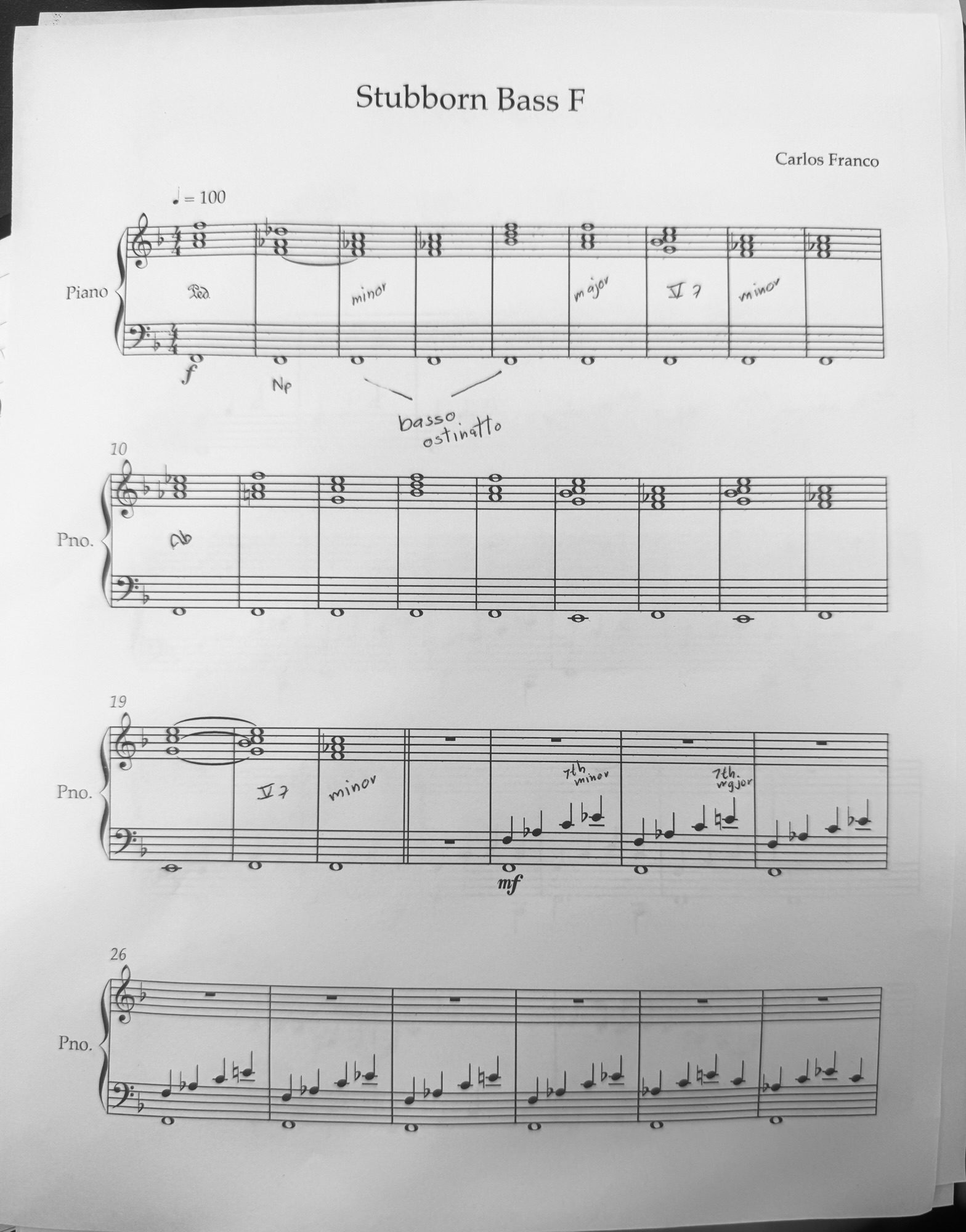
Veamos la partitura:
Los primeros compases rinden homenaje directamente al Concierto para piano “Emperador” de Beethoven. En este caso, el piano actúa como la orquesta y el bajo eléctrico interpreta la parte que, en la obra del compositor alemán, corresponde al piano. La interacción entre ambos instrumentos funciona estableciendo un acorde mayor seguido de 4 compases de improvisación libre del bajo. Vale la pena mencionar que, en las obras de Beethoven, aquello que originalmente se concebía como improvisación terminó por convertirse en música escrita en la partitura, como cualquier otra línea melódica.
Primer contraste: El motivo aparece en el compás 12 claramente en tonalidad de Do, pero luego se transforma a Do mixolidio, que actúa como dominante secundaria hacia Fa en el compás 15. Inmediatamente después, el motivo aparece en retrogradación en los compases 16 y 17 (segundo contraste).
Tercer contraste: surge en el compás 18, donde el motivo reduce su figura rítmica de semicorchea a corchea (aumentación).
Cuarto contraste: se encuentra en el compás 23, donde el ritmo cambia a corcheas (disminución), dando mayor protagonismo al bajo eléctrico, que se desplaza con un carácter de walking bass. Además, en ese mismo compás, un acorde de Re menor toma el protagonismo sin modular completamente a esa tonalidad.
En el compás 28 ocurre un quinto contraste en el piano, donde se presenta un intercambio modal, pasando de Re menor a Re mayor y luego a Re locrio en el compás 29.
El compás 29 muestra otro cambio: vuelve al motivo original en Do, pero súbitamente se desplaza a su paralelo menor, Do menor (sexto contraste).
La tonalidad cambia nuevamente a Re menor en el compás 34 y el modo pasa a Re locrio, y otra vez a Mi bemol en los compases 35 y 36 respectivamente. Esto representa un séptimo contraste, hasta que finalmente modula a Mi mayor en el compás 39.
De los compases 40 a 47 el bajo toma la melodía en Mi. Surge el octavo contraste y de 48 a 50 se visita la tonalidad de Re menor.
Desde el compás 51 la tonalidad cambia a su paralelo mayor, Re, y el piano vuelve a tomar protagonismo (noveno contraste). La armonía cambia de Si menor a Re, y en los compases 55 a 59 el bajo y el piano dialogan en movimiento contrario (décimo contraste). Los compases 57 a 59 avanzan lentamente para anunciar el final de la pieza.
El undécimo y último contraste, de los compases 60 a 63, presenta el motivo original disminuido en tiempo y tempo, a manera de despedida.
La grabación puede escucharse aquí:
 Carlos, siendo franco