Four to Three for Piano and Bass

Following, as an exercise, the techniques proposed by Gonzalo Macías in “Doce maneras de Abordar la Composición Musical”, we move on to number 4. In his book, Dr. Macías discusses superimposing ternary rhythms against binary ones.

The Mexican composer’s method is very interesting; it is even worth examining how he subdivides measures based on the smallest rhythmic unit. This appears in Chapter IV of his book.

In our case, we decided to follow an approach closer to what we are familiar with and chose to write a piece for two instruments: piano and bass. Each instrument carries one of the suggested rhythms: the piano is responsible for the sixteenth-note groupings, while the bass carries a melody built on triplets.

For more information, the reader may consult the score here:

The final result was documented in a performance by the author in this video:


Four against Three

The piece is in C Lydian mode and closes in C major. The idea was to present the rhythmic relationship mentioned above, with a short interlude that plays with inversions of C major and D.

“Cuatro contra Tres” para Piano y Bajo

Siguiendo a manera de ejercicios las técnicas propuestas por Gonzalo Macías en “Doce maneras de Abordar la Composición Musical” vamos con la número 4. En su libro, el Dr. Macías habla de super poner rítmicas ternarias contra binarias.

El método del compositor mexicano es muy interesante, vale la pena incluso ver como sub-divide los compases con base en la mínima unidad rítmica. Está en el capítulo IV de su libro.

En nuestro caso decidimos seguir un enfoque más cercano a lo que conocemos y optamos por escribir una pieza para dos instrumentos: piano y bajo. Cada uno hará una de las rítmicas sugeridas, el piano se encargará de los grupos de dieciseisavos y el bajo lleva una melodía con tresillos.

Para mayor información el lector/lectora puede mirar aquí la partitura:

El resultado final se documentó interpretado por el autor en este video:

Cuatro contra Tres

Está en un modo Do lidio, para cerrar en Do mayor, la idea era exponer la rítmica arriba mencionada con un pequeño intermedio que juega con inversiones de Do mayor y Re mayor. La pieza es una miniatura pensada para estudiantes de bajo eléctrico de la BUAP.

“Aire” para flauta

Un aire en música es la forma de denominar una melodía para una sola voz, he aquí un ejemplo escrito por un servidor:

La interpretación corre a cuenta del maestro Héctor Pérez, flautista. Un joven maestro originario de Puebla capital.

Esta composición está realizada siguiendo la recomendación número tres del maestro Macías en su libro Doce Maneras de Abordar la Composición Musical. El lector o lectora lo puede conseguir en este vínculo:

https://es.scribd.com/document/720664690/Doce-maneras-de-abordar-la-composicio-n-musical-Gonzalo-Maci-as-1

En este caso, nos valimos de la famosa Brandinerie de Bach. Que se muestra abajo. A la composición se le hicieron variaciones quedando la siguiente idea:

En su capítulo III, Gonzalo Macías propone que para componer una melodía para un instrumento que no conocemos podemos partir de un fragmento musical ya existente en dicho instrumento y de ahí realizar modificaciones.

Para conocer un poco más del registro del instrumento, revisamos también, tal como sugiere el libro, un fragmento de Debussy en Siesta de un Fauno.

Luego de ver esto quizás se piense que estamos plagiando a otro autor pero muchas obras musicales hoy célebres, derivan de obras musicales anteriores. Es una práctica común.

Podemos así, con toda confianza, realizar composiciones que sabemos funcionarán bien en la práctica.

Air for flute

In music, an air is the term used to refer to a melody for a single voice; here is an example written by the author:

The performance is by Maestro Héctor Pérez, a flutist—a young master originally from the city of Puebla.

This composition was created following recommendation number three by Maestro Macías in his book Doce Maneras de Abordar la Composición Musical. The reader can access it at the following link:

https://es.scribd.com/document/720664690/Doce-maneras-de-abordar-la-composicio-n-musical-Gonzalo-Maci-as-1

In this case, we made use of Bach’s famous Badinerie, shown below. Variations were applied to that composition, resulting in the following idea:

In Chapter III, Gonzalo Macías proposes that in order to compose a melody for an instrument we are not familiar with, we can start from an existing musical fragment written for that instrument and then make modifications.

To gain a better understanding of the instrument’s range, we also reviewed—as the book suggests—a fragment from Debussy’s Prélude à l’après-midi d’un faune.

After seeing this, one might think that we are plagiarizing another author, but many musical works that are celebrated today derive from earlier compositions. This is a common practice.

In this way, we can confidently create compositions that we know will work well in practice.

A drawing: Another approach to melody

Another idea proposed by Gonzalo Macías in his book Doce Maneras de Abordar la Composición is to begin by drawing the duration of the notes in a melody.

A long line can represent a long note, and the same principle applies to short notes. We created an example based on the following drawing:

On the left side, horizontal lines represent the duration of each note. The vertical lines represent the pulse or beat. In this case, each beat lasts five seconds. The drawing on the right shows its equivalent in rhythmic notation. The reader should note the 5/4 time signature, played at one quarter note per second.

Drawing and its equivalent in notation

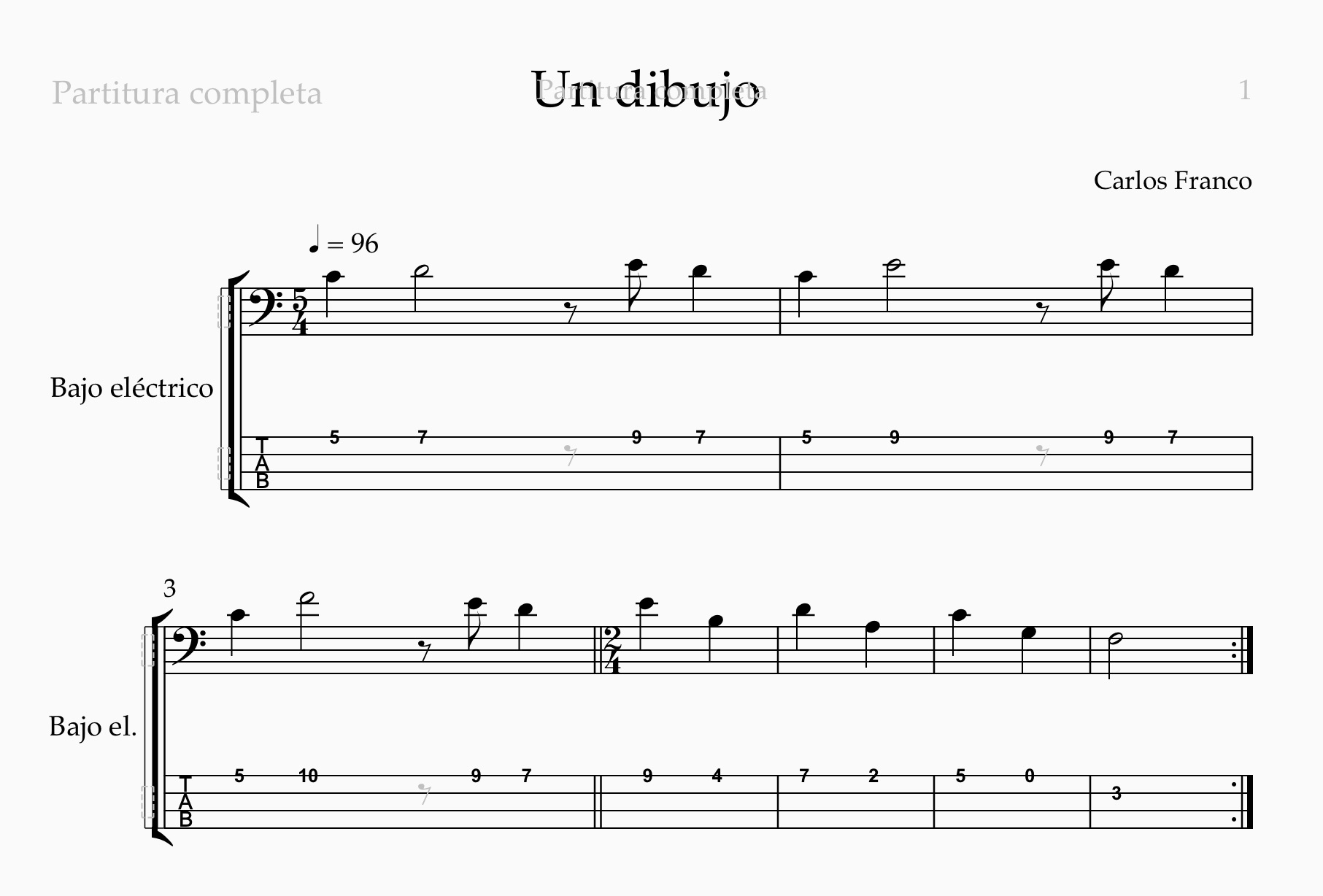
That rhythmic pattern is repeated three more times, with variations in the third note of the measure. Finally, a closing gesture is sought for the melodic idea. In the example produced by the author of these lines, the result was the following score:

Notice how the final measures change to 2/4 in order to approach the closing of the piece by fifths.

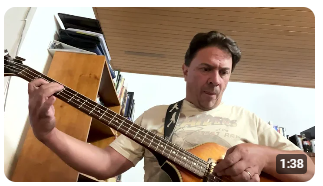
It is a simple idea; however, it serves to test Macías’s ideas regarding approaches to composition. The final result appears in the following video and is the third piece in the series Miniatures for Bass.

Un dibujo: Otro enfoque para aproximarse a la composición de melodía

Otra idea que propone Gonzalo Macías en su libro “Doce Maneras de Abordar la Composición” es comenzar haciendo un dibujo de la duración de las notas en una melodía.

Una línea larga puede significar una nota larga, y análogamente funciona para notas breves. Hicimos un ejemplo basado en el siguiente dibujo:

Del lado izquierdo aparecen líneas horizontales que representan la duración de cada nota. Las líneas verticales representan el pulso o beat. En este caso son cinco segundos. El dibujo de la derecha representa su equivalente en figuras rítmicas. Observe el lector o lectora el compás de 5/4 que se toca a una negra o cuarto cada segundo.

Dibujo y su equivalente en notas

Ese patrón rítmico se repite tres veces más haciendo variaciones en la tercera nota del compás. Finalmente se busca un cierre a la idea melódica. En el ejemplo que realizó quien escribe estas líneas dió como resultado esta partitura:

Obsérvese como los últimos compases cambian a 2/4 para ir aproximándose por quintas a un cierre del tema.

Es una idea simple, sin embargo sirva para probar las ideas de Macías sobre acercamientos a la composición. El resultado final aparece en este video y es la tercera de la serie “Miniaturas para Bajo”.

Miniatura para Bajo 3

Cazando una línea 2 (basado en el trabajo de Macías)

Este tema es una composición basada en el libro de Gonzalo Macías “Doce Maneras de Abordar la Composición Musical”. https://www.scribd.com/document/720664690/Doce-maneras-de-abordar-la-composicio-n-musical-Gonzalo-Maci-as-1

En su primer ejercicio titulado “Cazando una Línea”, Macías propone ir anotando la altura de las notas en el pentagrama sin importar su rítmica.

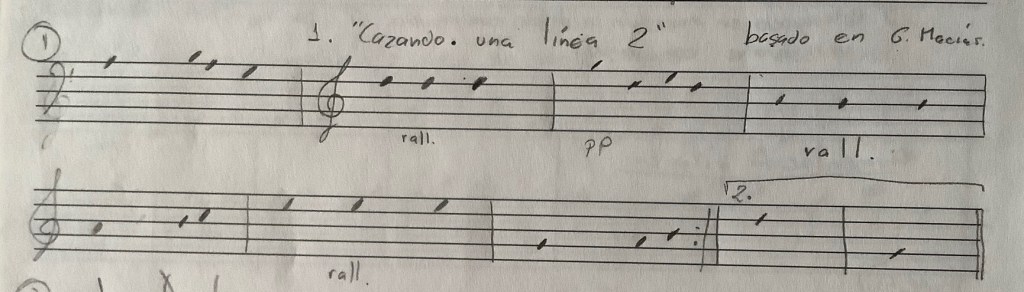
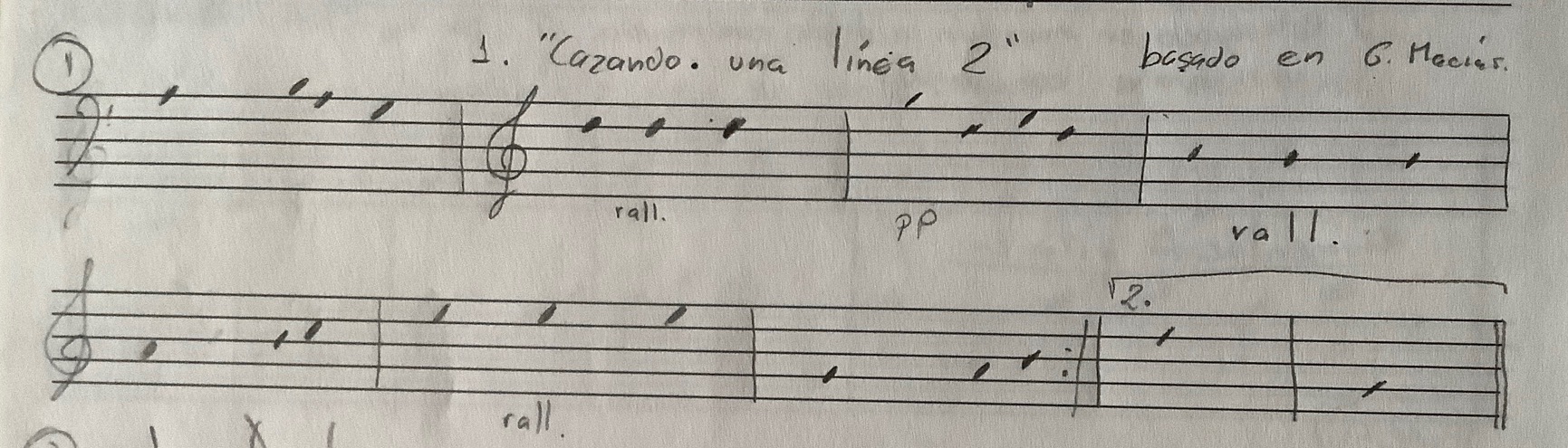
El objeto de esto es evitar distraerse pensando en ritmo y pulso y buscar enfocarse en la creación de la melodía. He aquí el ejemplo obtenido por un servidor:

Ejemplo Manuscrito “Cazando una línea 2”

Como segundo paso, el maestro Macías propone llevar dicha línea a todos los intervalos posibles de una tonalidad y de tonalidades cercanas.

Posteriormente, se busca dar un sentido coherente a los motivos musicales ahí expuestos. En el caso de un servidor hay dos motivos claros. En el compás 1, está una nota larga seguida de tres más cortas. En el segundo compás una misma nota repetida tres veces haciendo ralentando. Ese mismo esquema de motivo se repite en compases 3 y 4 y después en 4 y 5. Los compases 6 y 7 son básicamente el cierre de la melodía.

Si observamos el diseño, es una melodía tipo call-response, donde el primer compas expone el motivo y el segundo una resolución al mismo. El resto de la composición repite ese mismo esquema con diferentes alturas. Con esto se consigue una coherencia melódica.

En el ejemplo del libro, el maestro Gonzalo decide usar un Fender Rhodes para su interpretación. En nuestro caso decidimos convertirla en una miniatura para bajo eléctrico. He aquí el resultado final:

Miniatura para Bajo vol. 2

“Hunting a Line 2” based on Macias´ work

This piece is a composition based on Gonzalo Macías’s book Doce Maneras de Abordar la Composición Musical.
https://www.scribd.com/document/720664690/Doce-maneras-de-abordar-la-composicio-n-musical-Gonzalo-Maci-as-1

In his first exercise, titled “Cazando una Línea” (“Hunting a Line”), Macías proposes writing down the pitch of the notes on the staff without paying attention to their rhythm.

The purpose of this is to avoid getting distracted by thinking about rhythm and pulse, and instead to focus on the creation of the melody. Here is the example obtained by the author of these lines:

Handwritten Example “Cazando una línea 2”

As a second step, Maestro Macías suggests taking that line through all the possible intervals within a key and in neighboring keys.

Afterwards, the goal is to give coherent meaning to the musical motives presented there. In my case, there are two clear motives. In measure 1, there is a long note followed by three shorter ones. In the second measure, the same note is repeated three times, creating a rallentando. This same motivic scheme is repeated in measures 3 and 4, and then again in measures 4 and 5. Measures 6 and 7 essentially serve as the closing of the melody.

If we observe the design, it is a call-and-response type melody, where the first measure presents the motive and the second provides a resolution. The rest of the composition repeats this same scheme at different pitch levels. This approach achieves melodic coherence.

In the book’s example, Maestro Gonzalo chooses to use a Fender Rhodes for his interpretation. In our case, we decided to turn it into a miniature for electric bass. Here is the final result: