Suspensiones armónicas

En la composición, hay estrategias para generar tensión resolución en melodías o armonizaciones entre dos voces. Esta relación entre tensión resolución se le conoce como suspensión armónica. Se clasifican de acuerdo con la relación que guardan las notas de tensión y resolución en relación con el bajo.

De acuerdo a dicha relación con el bajo se clasifican en:

4-3, 7-6, 9-8 o 2-3, es decir si se forma una cuarta con respecto al bajo y la melodía desciende a una tercera, en el segundo caso cuando se mueve de séptima a sexta y así sucesivamente.

Es importante considerar que, por lo general, la suspensión disonante debe tener preparación consonante y resolverse a una nota consonante. De esta manera se consigue un mejor efecto de curva en la melodía.

La otra recomendación es que la preparación previa y resolución consecuente deben ser al menos tan largas como la suspensión que queda en medio.

Dejamos aquí un ejemplo en esta pequeña pieza para guitarra acústica titulada Pasaje:

Y como es costumbre dejamos aquí la partitura para quien quiera hacer intento de tocarla

Ojalá el lector o lectora disfrute de la pieza, seguimos publicando música para el deleite de todos.

Harmonic Suspensions

In composition, there are strategies to create tension and resolution in melodies or in the harmonization between two voices. This relationship between tension and resolution is known as a harmonic suspension. Suspensions are classified according to the relationship between the tension and resolution notes in relation to the bass.

According to their relationship with the bass, they are classified as 4–3, 7–6, 9–8, or 2–3. In other words, when the melody forms a fourth above the bass and then descends to a third; in the second case, when it moves from a seventh to a sixth, and so on.

It’s important to note that, in general, the dissonant suspension should have a consonant preparation and resolve to a consonant note. This helps achieve a more natural and expressive melodic curve.

Another recommendation is that the preparation and resolution should each last at least as long as the suspension itself.

Here’s an example in this short piece for acoustic guitar titled Pasaje:

And as usual, here is the score in case the reader wants to give it a try:

We will carry on writing about music, for the reader´s enjoyment.

Usando el acorde disminuido en primera inversión

Es bien sabido que ocurre una inversión de acorde cuando la nota del bajo no es la fundamental de la tríada. En el caso del vii°, la nota del bajo sería la tercera del acorde. En Do mayor, el séptimo grado es Si, y sus notas serían Si, Re, Fa, por lo tanto vii° sería Re, Fa, Si.

Cuando se usa un acorde de cuatro notas duplicando la fundamental, vii° lógicamente se convierte en Re, Fa, Si con un Si extra. Tener dos notas sensibles produce la sensación de inestabilidad, por lo que normalmente se duplica la tercera en su lugar. En el ejemplo dado, vii6 se convertiría en Re, Fa, Si, Re.

La siguiente pregunta del lector probablemente sería: “¿Cuándo voy a usar vii6 (que es lo mismo que B°/D)?”

Se puede usar para cambiar I6 de vuelta a I, dando la sensación de una cadencia V-I. En la mayoría de los casos, incluso puede sustituir un acorde V4/3 (V7/D) debido a que es casi idéntico excepto por una nota.

Como hemos hecho previamente con otros conceptos musicales, dejamos un pequeño fragmento para voz y piano que ejemplifica el uso de este acorde.

El lector puede escuchar la pieza en el siguiente enlace:

Using a diminished chord in first inversion

It is well known that a chord inversion occurs when the bass note is not the triad´s fundamental. In the case of the vii°, the bass note would be the third of the chord. When in C major, the seventh grade is B, D, F, therefore vii° would be D,F,B.

When using a four note chord doubling the fundamental, vii° logically becomes D,F,B with an extra B. Having two sensitive notes produces the senstaion of unstability, it is then accoustomed to double the third instead. In the given example vii6 would become D F B D.

The reader´s next question would probably be: “When am I going to use vii6 (which is the same of B°/D)?”

It can be used to change I6 back to I giving the sense of a V-I cadence. In most cases it can even substitute a V4 3 (V7/D) chord, since it is almost identical except for one note.

As we have prevoiusly done with other musical concepts we leave a small piece for voice and piano to exemplify a usage of this chord.

The reader can listen to the piece in the following link:

El valor del Dinero

El dinero es una de esas cosas que creemos entender hasta que nos detenemos a pensarlo en serio.

Sabemos cuánto tenemos, cuánto nos falta, cuánto “deberíamos” ganar.

Pero rara vez nos preguntamos qué es realmente eso que tanto perseguimos.

No hablo del valor de cambio ni de la economía global.

Hablo del valor del dinero como idea, como energía, como reflejo de lo que somos y de lo que tememos ser.

El dinero como herramienta

En su forma más simple, el dinero es solo eso: una herramienta de intercambio.

Una forma práctica de decir: “esto vale tanto esfuerzo, tanto tiempo, tanta atención”.

Cada billete, cada número en una pantalla, representa minutos de vida.

Y ahí vale hacerse una pregunta sencilla, casi brutal:

¿Esto vale el tiempo de mi vida que estoy entregando a cambio?

A veces la respuesta es sí, y se siente bien.

Otras veces, no. Y ese “no” pesa más que cualquier factura.

El dinero como emoción

El dinero nunca es solo dinero.

Es miedo, deseo, culpa, orgullo, ambición, vergüenza.

Cada impulso de gastar o de ahorrar tiene una raíz emocional.

Algunos buscan dinero porque anhelan libertad.

Otros, porque necesitan control.

Y hay quienes lo acumulan no por amor a la abundancia, sino por miedo a perder.

Pero el dinero no cura esos vacíos.

Solo los amplifica. Las emociones se manejan desde el interior.

El dinero como símbolo

En el fondo, el dinero es una forma de energía social.

Sirve para medir valor, pero no valor humano.

Ahí es donde solemos enredarnos:

confundimos lo que tenemos con lo que somos.

Creemos que el saldo en la cuenta mide el peso de nuestra existencia.

No.

El dinero mide transacciones, no sentido.

Ponerlo en su lugar

Pensar en el valor del dinero no es despreciarlo.

Es recordarle su sitio.

El dinero sirve cuando trabaja para ti,

no cuando te convierte en su empleado.

Porque si el dinero se vuelve tu centro,

entonces no tienes fortuna:

la fortuna te tiene a ti.

Polychords, applied to a composition

Now we will present the use of polychords in a piano composition of mine.

We provide the audio and show the score here:

The polychords appear from the very beginning. The first measures display them; according to Persichetti (1985), it is advisable that the lower chord have the voices as open as possible to avoid sounding too “muddy.” In this piece, instead of using a block chord, we limit the left hand to bass notes on the root and fifth of a C major chord. It is worth mentioning that these are the only bass notes used throughout the entire piece.

The right hand of the piano presents the upper chord; the progression goes A, B, D, F, and C. In measure 5, the theme changes but continues the idea of polychords: C, D, B♭, and C appear in the right hand.

In measure 9, there is a third theme that creates a kind of 3-against-2 polyrhythm; the bass continues alternating between C and E, while the right hand insists on a B♭. From there, the piece moves forward until measure 13, where the initial themes return.

Measure 27 introduces a melodic idea moving toward the Lydian mode of C. It can be seen that the chord in the bass remains insistent: a C major chord. Finally, the piece closes by revisiting the first two themes and resolving on C, giving a sense of tonality.

Poliacordes, una ejemplo de composición

Ahora presentaremos el uso de poliacordes en una composición para piano de un sevridor:

Dejamos el audio y aquí mostramos la partitura:

Los poliacordes aparecen desde el principio. Los primeros compases los muestran, de acuerdo con Persichetti (1985)1, es recomendable que el acorde inferior tenga las voces lo más abierto posible para evitar que suene muy “sucio”. En el caso de esta pieza, evitamos un acorde en bloque y nos limitamos a hacer notas de bajo con la fundamental y la quinta de un acorde de Do mayor. Cabe mencionar que son las únicas notas de bajo utilizadas en toda la pieza.

La mano derecha del piano muestra justamente el acorde superior, la progresión va con A, B, D, F y C. El compás 5 hace un cambio en el tema pero sigue con la idea de poliacordes C, D, Bb y C surgen en la mano derecha.

En el compás 9 hay un tercer tema que hace una especie de polirritmia 3 contra 2 el bajo sigue jugando Do y Mi y la mano derecha insiste con un Bb. De ahí nos vamos hasta el compás 13 donde retoma los temas del inicio.

El compás 27 hace una idea melódica moviéndose a Do lidio. Se puede ver que el acorde en el bajo es insitentemente un Do mayor C. Finalmente cerramos la pieza con los primeros dos temas hasta caer a un C que nos da la idea de tonalidad.

  1. Persichetti, V. (1985). Armonía del siglo XX. Real Musical. ↩︎

Tonal Regions: Example with a piano piece

I am interested in sharing the topic of tonal regions; in this case, we will apply it to one of my own compositions for solo piano. In his book Structural Functions of Harmony, the notable composer Arnold Schoenberg shows that there is, in fact, no real change of key in a composition unless the modulation to the new key lasts for a considerable amount of time or for the remainder of the musical piece.

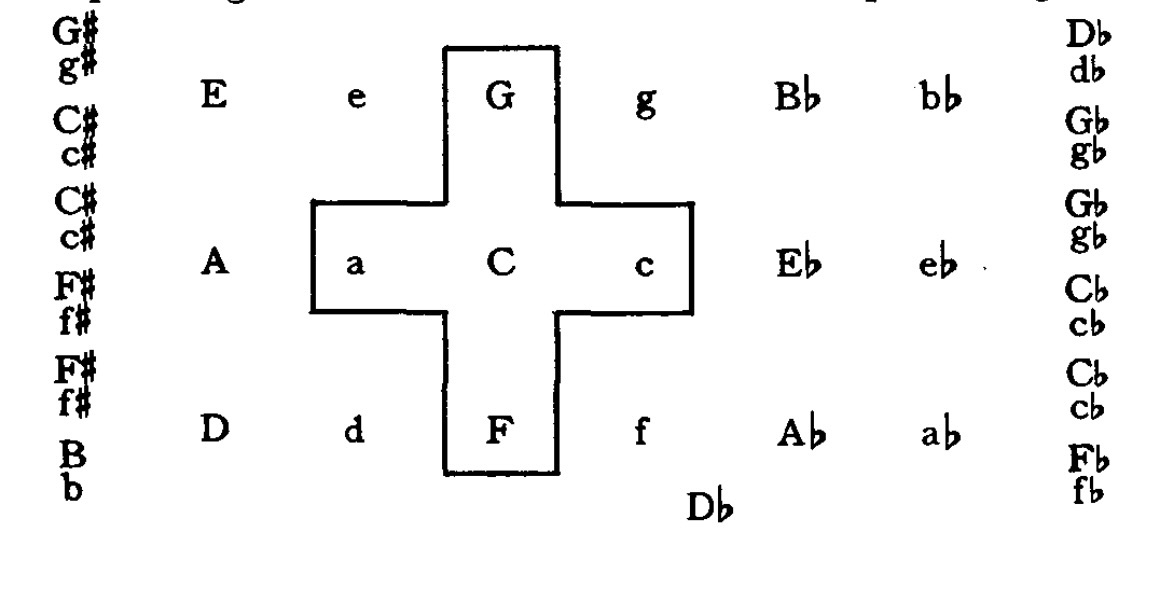
The author suggests that one can move through different tonal regions, some closer to others, according to this “map”:

“Tonal Regions according to Schoenberg”

The piece discussed can be listened to below:

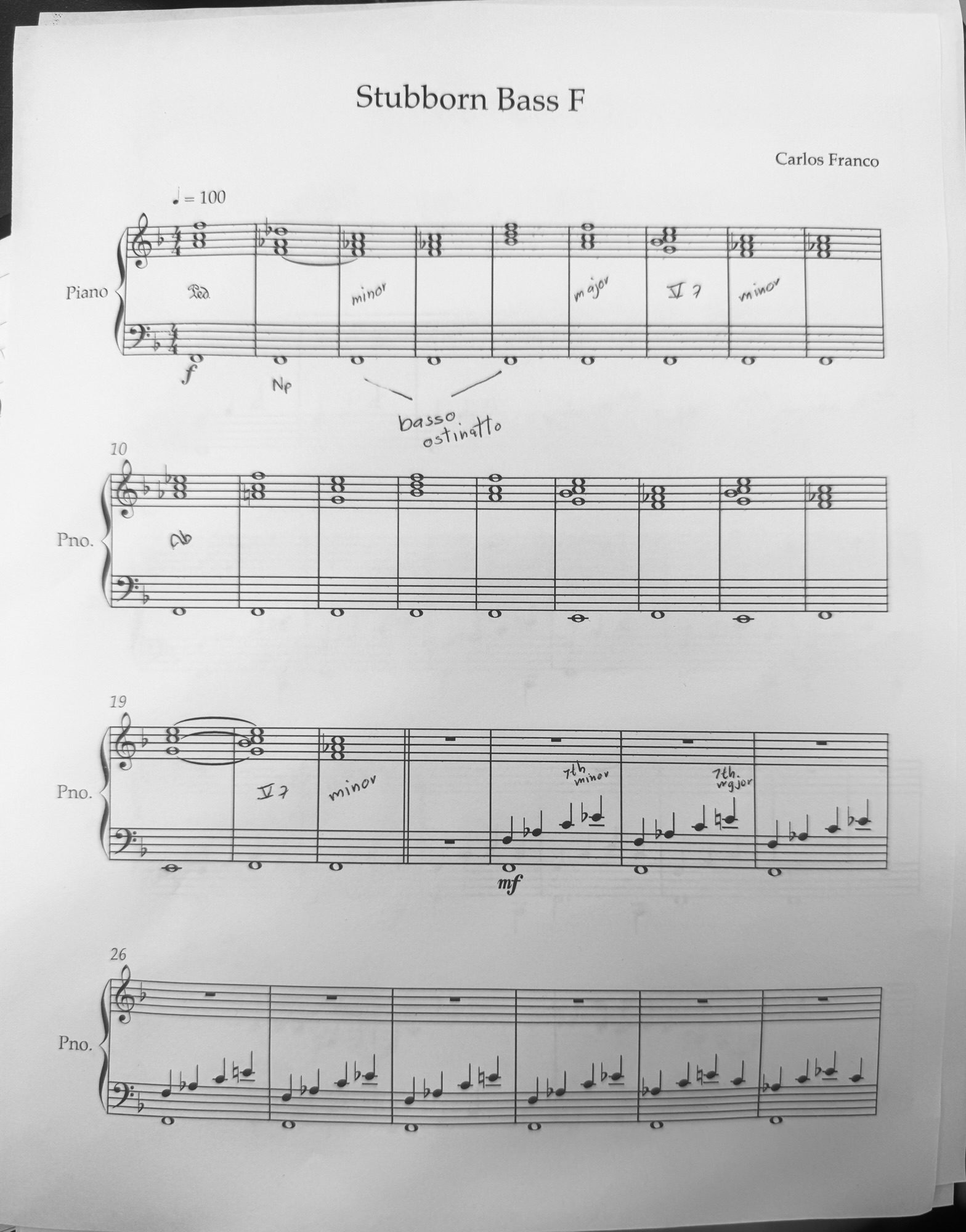
In that piece we have a constant feature: the ostinato bass on F in the left hand of the piano. From there, we can observe the following as shown in the score:

First Page “Stubborn Bass in F

As we can see in the third measure, the piece falls into F minor through a Neapolitan sixth (Np6) in the second measure. In the sixth measure, F returns without much announcement, and through the C7 (V7) it modulates back to minor in the eighth measure.

Then, in measure 10, Ab appears as another chord of the key that would originally be F minor, which somehow establishes itself by resolving in measures 20 and 21 with a V7–I cadence of C7–Fm.

In measure 23 begins the second part of the piece, where several arpeggios are played while maintaining the continuo bass on the note F, at times emphasizing its fifth to give some variation to the left hand. In this second part of the piece, there is no real change of region except for the seventh, which alternates between major and minor (E and Eb, respectively, in measures 23 and 24).

The third part of the piece belongs to a genre that has always played with minor melodies and major accompaniments: the Blues. If we look at blues pieces, the famous “blue note” is nothing more than the minor third and minor seventh of a major key, and this is what gives the genre its distinctive character.

Finally, we leave the score here in case any reader wishes to try it out in their free time; it is extremely simple:

Improvisar es vivir: lecciones de Free Play

Improvisar suele sonar a riesgo, a vértigo. En música, muchos lo imaginan como lanzarse sin partitura, sin red, a un abismo donde cualquier error puede arruinarlo todo. Pero Stephen Nachmanovitch, en su libro Free Play: Improvisation in Life and Art, nos propone otra mirada: la improvisación no es caos, sino la esencia misma de la creatividad y de la vida.

Desde niños improvisamos al jugar, inventando mundos con una caja de cartón o transformando sonidos en canciones. Con los años, las reglas, la técnica y el miedo al error nos endurecen. Free Play nos recuerda que improvisar no significa carecer de estructura, sino escuchar profundamente: al otro, al entorno, al momento presente.

Nachmanovitch afirma que el error es materia prima. Un “desliz” puede abrir un camino inesperado y brillante, si en lugar de resistirlo lo seguimos. Esa es quizá la gran enseñanza: la improvisación es un ejercicio de confianza radical en el presente. No se trata de controlar, sino de soltar y permitir que la vida —o la música— se despliegue a través de nosotros.

La improvisación, entonces, trasciende lo artístico: está en cada conversación, en cada decisión no planeada, en cada giro inesperado de la vida. Todos improvisamos, aunque no lo llamemos así.

Quizá lo más liberador de Free Play es comprender que no hay que ser un virtuoso para improvisar. Basta con atreverse a estar en el ahora, abrirse a la sorpresa y dejar que fluya. Porque al final, improvisar no es otra cosa que vivir con los sentidos despiertos y el alma disponible.

Sound as faceless body: Abstract Composition

There is no melody.
There is no recognizable form.
Only a vibration that insists, unfolding like fog over the sonic field.

Abstract composition does not seek to please.
It does not seduce.
It does not explain.
It is a body without a face, moving by intuition,
as if sound had a memory of its own
and I were merely the medium that lets it pass through.

It works with textures.
White noise filtered as if it were silk.
A low pulse that does not mark time, but breath.
And a synthetic voice that says nothing, yet says everything.

I don’t know whether this will become part of an album.
I don’t know if anyone will listen to it.
But I know that, in making it, something inside me fell into place.

Abstraction is not evasion.
It is another form of presence.
One that needs no words, no face, no story.

Only sound.
Only gesture.
Only the moment when I stop being myself
and become vibration.

Music does not have to be melodic, harmonic, or even recognizable to be beautiful.
Sometimes the most moving thing is what cannot be named: a hum, a texture, a vibration that touches something deep without asking permission.
Beauty is not in the form, but in the honesty of the gesture.
And when that gesture is born from the most intimate place, even noise can become a poem