When using a two chord-porgression only

Sometimes in music, we don’t want to spend much time thinking of a creative harmony, there are two chords which are basic to accompany virtually any melody.

Those chords are the tonic I and the dominant V. Since the latter tends to solve to the first one, this combination works all the time and such chords can be used during a piece of music forming a nice ostinato~like harmonic rhythm.

As an example, we would like to present a pop song named Luz Del Corazon.

Let us analyze the recording to establish a point:

If one listens closer to the keyboard, it only moves from F to C. The rest of the song is fulfilled by drums rhythm, guitar, and the bass. Above all this comes the melody, with lyrics sung by the author of these lines.

The reader might ask:  “What makes this song interesting if it only presents two chords?” in this case, the answer is: variety in rhythm and melodic base line.

Rhythm guitar moves in eight notes, the recording has an effect on the guitar that makes them sound perfect in tempo. Therefore, it becomes a harmonic pad.

The bass on the other hand, “sings” a melody in counterpoint with the vocals. It basically plays notes from the arpeggios and major scales but imitates the singer rhythmically.

The melody of the song has two well defined parts: A and B. This condition helps to enhance the contrast melody-harmony.

It can be resourceful for the composer to have a simple harmonic progression, but compromise is necessary to make it sound interesting. The melody needs to take care of the variety, as well as accompanying instruments or voices.

We invite the reader to give it a try: Write a song using two chords only.


Key and Mode changes in a Piano/Bass piece

Usually Mode and key are modified to obtain the desired contrast in a composition. In this case we discuss different strategies of change using a piece for piano and electric bass.

Let´s look at the score:

The first bars directly pay tribute to Beethoven´s Emperor Piano Concerto, In this case, the piano acts as the orchestra and the electric bass plays the part of the piano in the german composer´s work. The interaction of both instruments works by establishing a major chord followed by 4 bars of free improvisation of the bass. It is worth mentioned that in Beethoven´s works, what was originally thought as improvisation, became music printed on the score as any other melodic part.

First contrast: The motif shows up in bar 12 it is clearly in the key of C but then it transforms to C mixolydian which acts as the secondary dominant to F in bar 15. Immediately afterwards the motif retrogrades in bars 16 and 17 (second contrast).

The third contrast appears in bar 18 where the motif reduces its time from 16th note to 8th note (augmentation).

Fourth contrast can be found in bar 23 where the rhythm changes to eight notes (diminution) giving more attention to the electric bass, that moves in a walking bass fashion. Also in bar 23 a Dm takes the lead without completely modulating to that key.

In bar 28 a fifth contrast occurs in the piano where a modal interchange takes place from Dm to D and then to D locrian in bar 29.

Bar 29 shows another change, this time it goes back to the original motif in C but it suddenly changes next to its parallel minor Cm (sixth contrast).

The key moves again to Dm in bar 34 and changes mode to D locrian and again to Eb in bars 35 and 36 respectively. This represents a seventh contrast till it finally moves to the key of E in bar 39.

From bars 40 to 47 the bass features taking the melody in E. The eight contrast appears and from 48 to 50 the key of Dm is visited.

From bar 51 the key changes to its parallel major D and the piano comes back predominantly again (ninth contrast). Harmony changes from Bm to D and in bar 55 to 59 the bass and the piano play around in contrary motion (tenth contrast). Bars 57 to 59 move slowly to announce the end of the piece.

The eleventh and last contrast from bars 60 to 63 present the original motif diminished in time and tempo to say goodbye.

The recording can be heard here:

Cycles, Repeating in Music is fine.

Once again we turn to Gonzalo Macías’s book Twelve Ways to Approach Musical Composition (Macías, 2014). In proposal number 5, titled “Cycles,” the Mexican composer suggests using the repetition of an idea as a compositional strategy.

In this case, we will apply his technique in a piano piece that can be heard at the following link:

La pieza en cuestión se denomina Cíclos, se construye sobre cuatro ideas que mostramos en las siguientes imágenes:

Patrón 1 en pieza cíclos
Pattern 1

This first pattern is the one that forms the first cycle, as it is repeated four times. You can consult the score to verify what is explained here, and of course you may play it if any curious soul feels like it.

From there we have a second motif, shown in the image below, which is also repeated 4 times. Starting at measure 17, the first pattern reappears with a variation in the notes.

Pattern 2 appears in second place

Pattern 1 goes through six cycles before giving way to a new pattern that presents only a group of sixteenth notes on the first beat. It is shown in the figure below.

Pattern 3 the closure motif

This cycle occurs five times, and in the last two of them it includes a chord on the last beat of measure 33 and the first beat of measure 34. To close the composition, in measures 37 to 39 patterns 1 and 2 reappear as a kind of farewell, finally leading into a traditional V–I to end the piece.

The rhythmic idea was inspired by Zeppelin’s “Kashmir,” at least that group of sixteenth notes that appears on beat 1 in the measures.

Tension and Release

A common way in which composition makes use of movements of tension and release is through the interplay between minor and major chords. In the composition shown below, we aim to provide an example of this.

Measures 1 through 6 play between the chords D minor and C-sharp minor. In fact, these are two minor chords a second apart, a relationship that sounds somewhat dark on its own.

The sense of calm appears in measure 9, where the theme previously presented with D minor and C-sharp minor becomes D minor and E major with a sixth. The latter chord closely resembles C-sharp minor, except for its B in the fifth, which makes the change subtle.

The brightness in the piece arrives at measure 12, where, with a simple change from F natural to F-sharp, we move from D minor to D major. Instead of shifting to E6, it moves toward an E major triad, giving the piece a touch of major-mode conventionality — something any grandmother would enjoy.

Finally, since we’re already on an E major chord, it resolves naturally to E major 7, which ultimately functions as the dominant resolving to its tonic in A major.

Here we include the audio so you can listen to it.

Air for flute

In music, an air is the term used to refer to a melody for a single voice; here is an example written by the author:

The performance is by Maestro Héctor Pérez, a flutist—a young master originally from the city of Puebla.

This composition was created following recommendation number three by Maestro Macías in his book Doce Maneras de Abordar la Composición Musical. The reader can access it at the following link:

https://es.scribd.com/document/720664690/Doce-maneras-de-abordar-la-composicio-n-musical-Gonzalo-Maci-as-1

In this case, we made use of Bach’s famous Badinerie, shown below. Variations were applied to that composition, resulting in the following idea:

In Chapter III, Gonzalo Macías proposes that in order to compose a melody for an instrument we are not familiar with, we can start from an existing musical fragment written for that instrument and then make modifications.

To gain a better understanding of the instrument’s range, we also reviewed—as the book suggests—a fragment from Debussy’s Prélude à l’après-midi d’un faune.

After seeing this, one might think that we are plagiarizing another author, but many musical works that are celebrated today derive from earlier compositions. This is a common practice.

In this way, we can confidently create compositions that we know will work well in practice.

A drawing: Another approach to melody

Another idea proposed by Gonzalo Macías in his book Doce Maneras de Abordar la Composición is to begin by drawing the duration of the notes in a melody.

A long line can represent a long note, and the same principle applies to short notes. We created an example based on the following drawing:

On the left side, horizontal lines represent the duration of each note. The vertical lines represent the pulse or beat. In this case, each beat lasts five seconds. The drawing on the right shows its equivalent in rhythmic notation. The reader should note the 5/4 time signature, played at one quarter note per second.

Drawing and its equivalent in notation

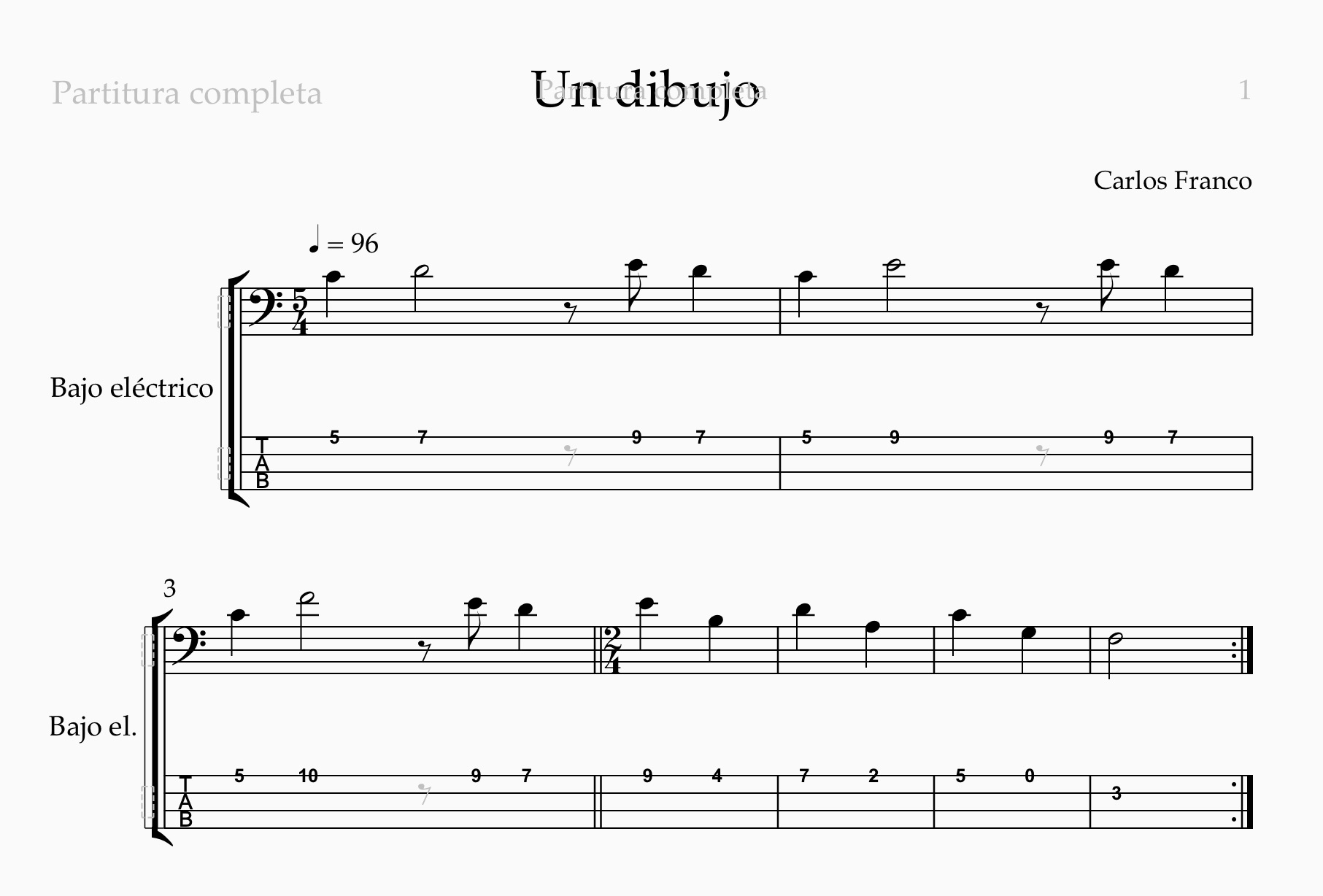
That rhythmic pattern is repeated three more times, with variations in the third note of the measure. Finally, a closing gesture is sought for the melodic idea. In the example produced by the author of these lines, the result was the following score:

Notice how the final measures change to 2/4 in order to approach the closing of the piece by fifths.

It is a simple idea; however, it serves to test Macías’s ideas regarding approaches to composition. The final result appears in the following video and is the third piece in the series Miniatures for Bass.