Usually Mode and key are modified to obtain the desired contrast in a composition. In this case we discuss different strategies of change using a piece for piano and electric bass.
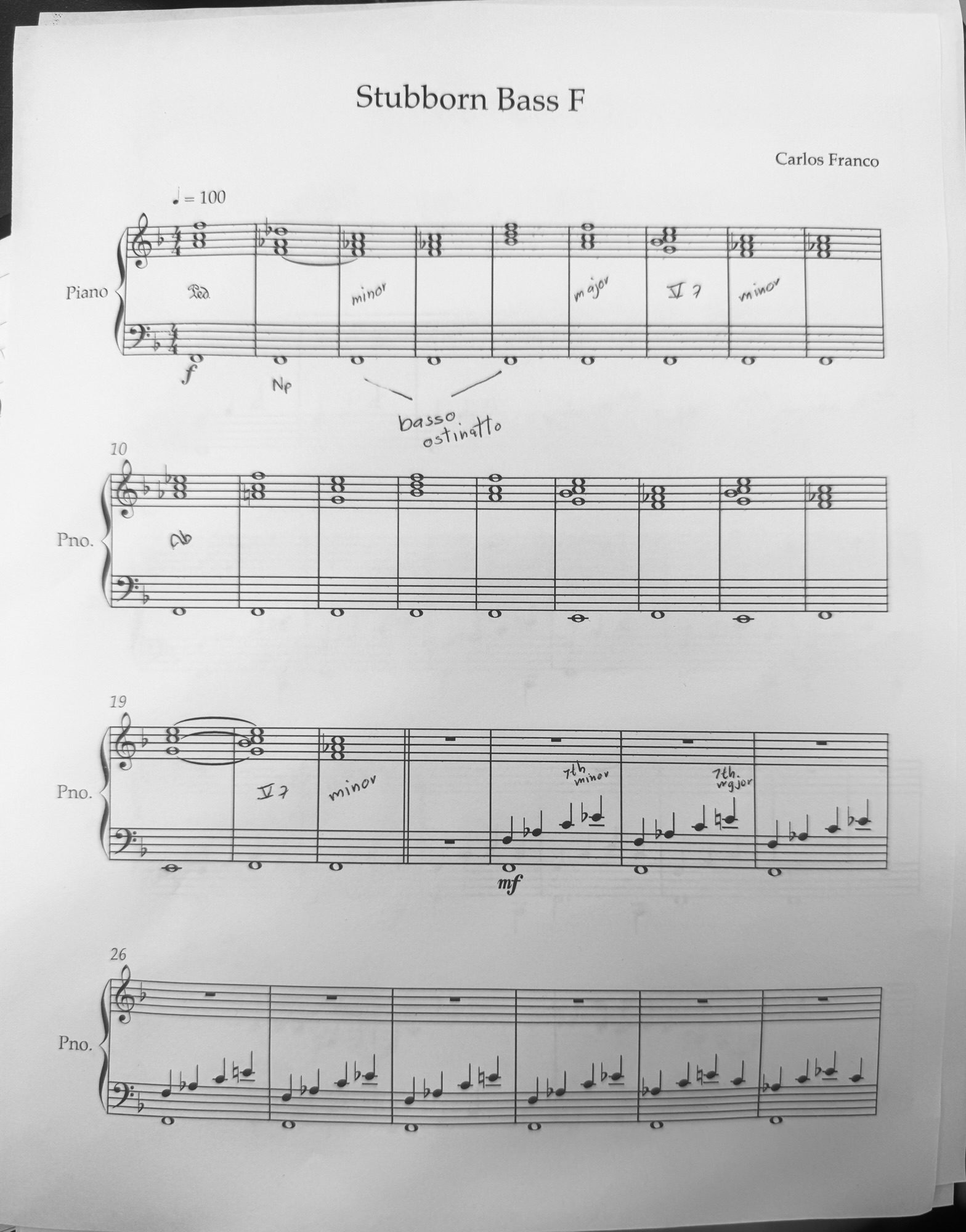
Let´s look at the score:
The first bars directly pay tribute to Beethoven´s Emperor Piano Concerto, In this case, the piano acts as the orchestra and the electric bass plays the part of the piano in the german composer´s work. The interaction of both instruments works by establishing a major chord followed by 4 bars of free improvisation of the bass. It is worth mentioned that in Beethoven´s works, what was originally thought as improvisation, became music printed on the score as any other melodic part.
First contrast: The motif shows up in bar 12 it is clearly in the key of C but then it transforms to C mixolydian which acts as the secondary dominant to F in bar 15. Immediately afterwards the motif retrogrades in bars 16 and 17 (second contrast).
The third contrast appears in bar 18 where the motif reduces its time from 16th note to 8th note (augmentation).
Fourth contrast can be found in bar 23 where the rhythm changes to eight notes (diminution) giving more attention to the electric bass, that moves in a walking bass fashion. Also in bar 23 a Dm takes the lead without completely modulating to that key.
In bar 28 a fifth contrast occurs in the piano where a modal interchange takes place from Dm to D and then to D locrian in bar 29.
Bar 29 shows another change, this time it goes back to the original motif in C but it suddenly changes next to its parallel minor Cm (sixth contrast).
The key moves again to Dm in bar 34 and changes mode to D locrian and again to Eb in bars 35 and 36 respectively. This represents a seventh contrast till it finally moves to the key of E in bar 39.
From bars 40 to 47 the bass features taking the melody in E. The eight contrast appears and from 48 to 50 the key of Dm is visited.
From bar 51 the key changes to its parallel major D and the piano comes back predominantly again (ninth contrast). Harmony changes from Bm to D and in bar 55 to 59 the bass and the piano play around in contrary motion (tenth contrast). Bars 57 to 59 move slowly to announce the end of the piece.
The eleventh and last contrast from bars 60 to 63 present the original motif diminished in time and tempo to say goodbye.
The recording can be heard here:


 Carlos, siendo franco