Los poliacordes aparecen desde el principio. Los primeros compases los muestran, de acuerdo con Persichetti (1985)1, es recomendable que el acorde inferior tenga las voces lo más abierto posible para evitar que suene muy “sucio”. En el caso de esta pieza, evitamos un acorde en bloque y nos limitamos a hacer notas de bajo con la fundamental y la quinta de un acorde de Do mayor. Cabe mencionar que son las únicas notas de bajo utilizadas en toda la pieza.
La mano derecha del piano muestra justamente el acorde superior, la progresión va con A, B, D, F y C. El compás 5 hace un cambio en el tema pero sigue con la idea de poliacordes C, D, Bb y C surgen en la mano derecha.
En el compás 9 hay un tercer tema que hace una especie de polirritmia 3 contra 2 el bajo sigue jugando Do y Mi y la mano derecha insiste con un Bb. De ahí nos vamos hasta el compás 13 donde retoma los temas del inicio.
El compás 27 hace una idea melódica moviéndose a Do lidio. Se puede ver que el acorde en el bajo es insitentemente un Do mayor C. Finalmente cerramos la pieza con los primeros dos temas hasta caer a un C que nos da la idea de tonalidad.
Persichetti, V. (1985). Armonía del siglo XX. Real Musical. ↩︎
I am interested in sharing the topic of tonal regions; in this case, we will apply it to one of my own compositions for solo piano. In his book Structural Functions of Harmony, the notable composer Arnold Schoenberg shows that there is, in fact, no real change of key in a composition unless the modulation to the new key lasts for a considerable amount of time or for the remainder of the musical piece.
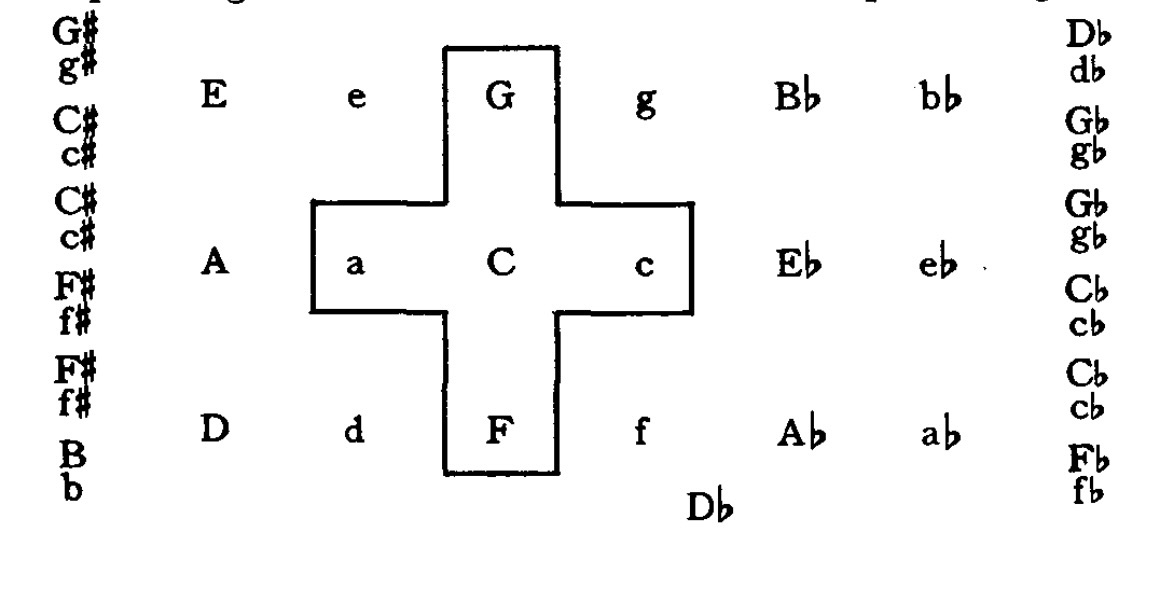
The author suggests that one can move through different tonal regions, some closer to others, according to this “map”:
“Tonal Regions according to Schoenberg”
The piece discussed can be listened to below:
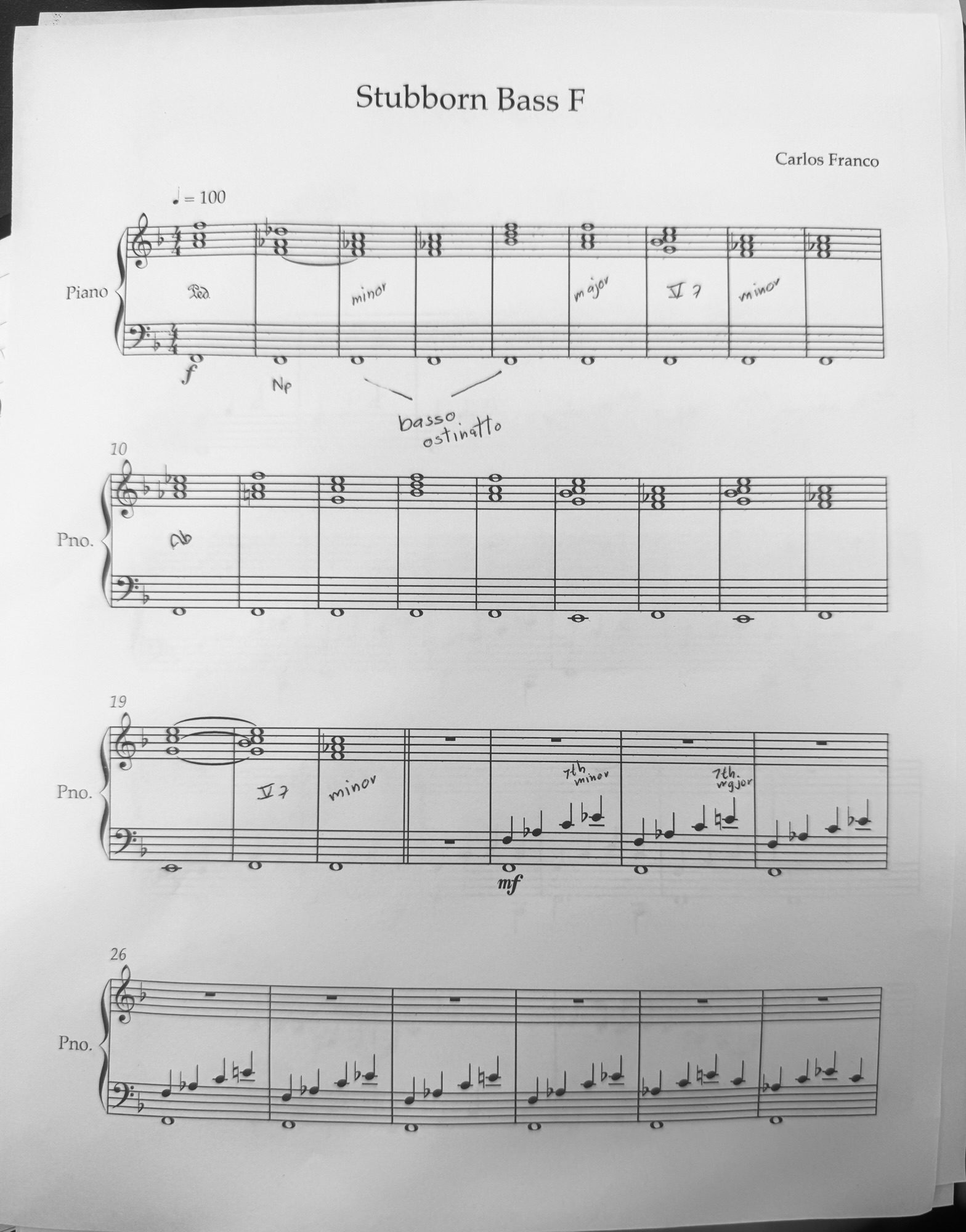
In that piece we have a constant feature: the ostinato bass on F in the left hand of the piano. From there, we can observe the following as shown in the score:
First Page “Stubborn Bass in F
As we can see in the third measure, the piece falls into F minor through a Neapolitan sixth (Np6) in the second measure. In the sixth measure, F returns without much announcement, and through the C7 (V7) it modulates back to minor in the eighth measure.
Then, in measure 10, Ab appears as another chord of the key that would originally be F minor, which somehow establishes itself by resolving in measures 20 and 21 with a V7–I cadence of C7–Fm.
In measure 23 begins the second part of the piece, where several arpeggios are played while maintaining the continuo bass on the note F, at times emphasizing its fifth to give some variation to the left hand. In this second part of the piece, there is no real change of region except for the seventh, which alternates between major and minor (E and Eb, respectively, in measures 23 and 24).
The third part of the piece belongs to a genre that has always played with minor melodies and major accompaniments: the Blues. If we look at blues pieces, the famous “blue note” is nothing more than the minor third and minor seventh of a major key, and this is what gives the genre its distinctive character.
Finally, we leave the score here in case any reader wishes to try it out in their free time; it is extremely simple:
There is no melody. There is no recognizable form. Only a vibration that insists, unfolding like fog over the sonic field.
Abstract composition does not seek to please. It does not seduce. It does not explain. It is a body without a face, moving by intuition, as if sound had a memory of its own and I were merely the medium that lets it pass through.
It works with textures. White noise filtered as if it were silk. A low pulse that does not mark time, but breath. And a synthetic voice that says nothing, yet says everything.
I don’t know whether this will become part of an album. I don’t know if anyone will listen to it. But I know that, in making it, something inside me fell into place.
Abstraction is not evasion. It is another form of presence. One that needs no words, no face, no story.
Only sound. Only gesture. Only the moment when I stop being myself and become vibration.
Music does not have to be melodic, harmonic, or even recognizable to be beautiful. Sometimes the most moving thing is what cannot be named: a hum, a texture, a vibration that touches something deep without asking permission. Beauty is not in the form, but in the honesty of the gesture. And when that gesture is born from the most intimate place, even noise can become a poem
No hay melodía. No hay forma reconocible. Solo una vibración que insiste, que se despliega como niebla sobre el campo sonoro.
La composición abstracta no busca agradar. No seduce. No explica. Es un cuerpo sin rostro que se mueve por intuición, como si el sonido tuviera memoria propia y yo solo fuera el médium que lo deja pasar.
Trabaja con texturas. Ruido blanco filtrado como si fuera seda. Un pulso grave que no marca tiempo, sino respiración. Y una voz sintética que no dice nada, pero lo dice todo.
No sé si esto será parte de un álbum. No sé si alguien lo escuchará. Pero sé que, al hacerlo, algo se ordenó dentro de mí.
La abstracción no es evasión. Es otra forma de presencia. Una que no necesita palabras, ni rostro, ni historia.
Solo el sonido. Solo el gesto. Solo el instante en que dejo de ser yo y me convierto en vibración.
La música no tiene que ser melódica, ni armónica, ni siquiera reconocible para ser hermosa. A veces, lo más conmovedor es aquello que no se puede nombrar: un zumbido, una textura, una vibración que toca algo profundo sin pedir permiso. La belleza no está en la forma, sino en la honestidad del gesto. Y cuando ese gesto nace desde lo más íntimo, incluso el ruido puede ser un poema.
La composición comenzó como una experimentación entre un acorde de C y un acorde de Eb. Ambos acordes están relacionados en su disposición (voicing). Comparten una nota común, que es G; la fundamental de Eb está a medio tono de la tercera de C, y la quinta de Eb está un tono por debajo de la fundamental de C.
La idea principal era transitar entre estos dos acordes manteniendo el bajo en C, lo cual corresponde a la fundamental y a la sexta en ambos acordes.
A partir de ahí, el autor juega con un acorde de C aumentado (Caug). El objetivo era probar distintos tipos de modulación utilizando el acorde aumentado. Primero, bajando su fundamental medio tono hasta B y moviéndose hacia un acorde de E, desplazando el bajo una tercera descendente para obtener la fundamental de E.
Después, el Caug aparece nuevamente para modular a C/Ab, bajando su tercera medio tono. El bajo permanece en C para mantener al mínimo el movimiento de las voces.
Finalmente, el Caug modifica su quinta aumentada bajándola medio tono para llegar a C y posteriormente sube medio tono para dirigirse a Am.
Luego aparece una segunda parte en la que la armonía alterna entre Cmaj7 y Dmaj7; nuevamente, la nota principal es C, que se desplaza medio tono hacia C#. Estos cambios conducen a una escala de acordes descendente que culmina en Am. Esta sección busca un carácter jazzístico.
Surge una nueva idea al regresar a la tonalidad de Ab presentada unos compases antes. En esta ocasión, el tempo cambia a Lento. En este punto de la obra, la intención es generar una sensación de balada. El bajo se mueve por semitonos entre G y Ab.
Posteriormente, la sección varía el tempo a Allegro; el bajo continúa desplazándose por semitonos y terceras hasta finalizar en C/Ab.
Aparece otra sección marcada como Andante, basada esencialmente en tres notas tomadas de otra obra del mismo autor: Eb, que se mueve alternativamente una tercera y una cuarta.
La pieza modula entonces a la tonalidad de Gm, avanzando en arpegios que incluyen una cuarta. La línea de bajo también es un arpegio de Gm (sus4), variando en duración.
Una cadencia final tiene lugar utilizando tríadas con un movimiento mínimo de voces. En este punto, el compositor intentaba cerrar en C en el compás 90, pero más tarde notó que la tonalidad exigía un Gm como acorde final. No se llega a este acorde mediante una cadencia típica V–i, sino que se cierra desde Cm hacia Gm, algo que recuerda a una cadencia plagal.
La composición se inspira principalmente en los cambios armónicos. No es rítmicamente compleja, salvo quizá por la síncopa en la primera sección. Cabe mencionar que la mayor parte de la obra fue escrita utilizando un controlador MIDI externo, lo cual reduce las posibilidades de ejecución. Gran parte de la pieza fue creada una mano a la vez. Resulta mucho más conveniente improvisar con un teclado estándar de cinco octavas.
¿Qué viene a la mente al escuchar la pieza?
La primera parte tiene un carácter algo funky, con un cambio armónico poco usual en la música popular. A partir de ahí, la idea se convierte casi en un ejercicio técnico sobre el acorde aumentado, explotando las posibilidades de modulación de la tríada.
Luego aparece la sección jazzística, que toma en cuenta el acorde de séptima mayor y aporta cierto alivio a la obra al contrastar con la sección de acordes aumentados.
La sección siguiente en Ab busca generar una atmósfera de balada. Esta sensación se mantiene hasta que se produce una pausa y la sección en Eb rompe con esa idea para introducir los arpegios en Gm, que constituyen la parte final de la pieza.
Conclusión general
La composición evoluciona de manera fluida a través de distintos pasajes, con cambios de tempo y modulaciones a tonalidades vecinas. Este tipo de suite merece ser explorado más a fondo en el futuro.
Otra línea interesante a desarrollar sería la composición con un enfoque más rítmico, buscando fortalecer las habilidades técnicas del intérprete en el instrumento.
The composition started as an experimentation between a C chord and an Eb chord. Both chord are voiced related. They share a common note which is G, the fundamental of Eb is half a step from C‘s third and the fifth in Eb is a step behind the root of C.
The main idea was to walk through these two chords keeping the bass in C which corresponds to the root and sixth in both chords.
From there, the author plays around with a Caug chord. The goal here was to try out the augmented chord different types of modulation. First by taking it’s root half a step down to B. Moving to an E chord. Moving the bass a third down to obaint E’s root note.
Then Caug comes again to modulate to C/Ab by moving its third half a step down. The bass remains in C to keep the voicing movement to a minimum.
Finally Caug changes its augmented fifth half a step down to go to C and subsequently moves half a step up going to Am.
Then comes a second part where the harmony changes between Cma7 and Dma7, again the main note is C changing half a step up to C#. These changes move to a descending chord scale that culminates on Am. This section looks for a jazzy feeling.
A new idea comes to place returning to the Ab key presented a few bars before. This time the tempo changes to Lento. At this time of the piece the idea is to produce the feeling of a ballad. The bass moves by semitones between G and Ab.
Then section varies tempo to allegro bass continues moving by semitones and thirds till is finished in C/Ab.
Another section appears as Andante, basically three notes taken from another piece by the same author. Eb moving alternatively a third and a fourth.
The piece modulates to the key of Gm, it moves in arpeggio with a fourth included. The bass line is also an Gm (sus4) arpeggio varying in duration.
A final cadence takes place within triads with minimum voice movement. At this point the composer was trying to close in C on bar 90, but it was later notes that the key demanded a Gm as the final chord. It doesn’t reach this chord with a typical V-i cadence, it closes form a Cm to Gm. Somewhat reminiscent of a plagal cadence.
The composition takes inspiration form harmonic changes. It is not rhythmically challenging except maybe for the syncopation on the first section. It is worth mentioning that most of the piece was written using an external midi keyboard controller. It reduces the possibilities of execution. Most of the piece was created one hand at a time. It is way much better to improvise with a regular size 5 octave keyboard.
What comes to mind when listening to the piece?
The first part is somewhat funky. An unusual change in harmony in popular music. From there the idea is almost a technical exercise on augmented chord, by exploiting the triad modulation possibilities.
Then comes the jazzy section, it takes into account the major seventh chord, but it gives the piece certain relieve by contrasting with the augmented chord section.
The next section with Ab tries to bring a balladistic atmosphere. This sensation is mantained until it pauses and the Eb section breaks with this idea to introduce the Gm arpeggios which is the final section of the piece.
General Conclusion
The composition evolves nicely into different passages and changes in tempo and modulation to neighbor keys. This sort of suite is worth being explored in the future.
Another idea to pursue is to compose more rhythmically oriented. Trying to develop the player’s technical abilities in the instrument.
Following, as an exercise, the techniques proposed by Gonzalo Macías in “Doce maneras de Abordar la Composición Musical”, we move on to number 4. In his book, Dr. Macías discusses superimposing ternary rhythms against binary ones.
The Mexican composer’s method is very interesting; it is even worth examining how he subdivides measures based on the smallest rhythmic unit. This appears in Chapter IV of his book.
In our case, we decided to follow an approach closer to what we are familiar with and chose to write a piece for two instruments: piano and bass. Each instrument carries one of the suggested rhythms: the piano is responsible for the sixteenth-note groupings, while the bass carries a melody built on triplets.
For more information, the reader may consult the score here:
The final result was documented in a performance by the author in this video:
Four against Three
The piece is in C Lydian mode and closes in C major. The idea was to present the rhythmic relationship mentioned above, with a short interlude that plays with inversions of C major and D.
Siguiendo a manera de ejercicios las técnicas propuestas por Gonzalo Macías en “Doce maneras de Abordar la Composición Musical” vamos con la número 4. En su libro, el Dr. Macías habla de super poner rítmicas ternarias contra binarias.
El método del compositor mexicano es muy interesante, vale la pena incluso ver como sub-divide los compases con base en la mínima unidad rítmica. Está en el capítulo IV de su libro.
En nuestro caso decidimos seguir un enfoque más cercano a lo que conocemos y optamos por escribir una pieza para dos instrumentos: piano y bajo. Cada uno hará una de las rítmicas sugeridas, el piano se encargará de los grupos de dieciseisavos y el bajo lleva una melodía con tresillos.
Para mayor información el lector/lectora puede mirar aquí la partitura:
El resultado final se documentó interpretado por el autor en este video:
Cuatro contra Tres
Está en un modo Do lidio, para cerrar en Do mayor, la idea era exponer la rítmica arriba mencionada con un pequeño intermedio que juega con inversiones de Do mayor y Re mayor. La pieza es una miniatura pensada para estudiantes de bajo eléctrico de la BUAP.
Un aire en música es la forma de denominar una melodía para una sola voz, he aquí un ejemplo escrito por un servidor:
La interpretación corre a cuenta del maestro Héctor Pérez, flautista. Un joven maestro originario de Puebla capital.
Esta composición está realizada siguiendo la recomendación número tres del maestro Macías en su libro Doce Maneras de Abordar la Composición Musical. El lector o lectora lo puede conseguir en este vínculo:
En este caso, nos valimos de la famosa Brandinerie de Bach. Que se muestra abajo. A la composición se le hicieron variaciones quedando la siguiente idea:
En su capítulo III, Gonzalo Macías propone que para componer una melodía para un instrumento que no conocemos podemos partir de un fragmento musical ya existente en dicho instrumento y de ahí realizar modificaciones.
Para conocer un poco más del registro del instrumento, revisamos también, tal como sugiere el libro, un fragmento de Debussy en Siesta de un Fauno.
Luego de ver esto quizás se piense que estamos plagiando a otro autor pero muchas obras musicales hoy célebres, derivan de obras musicales anteriores. Es una práctica común.
Podemos así, con toda confianza, realizar composiciones que sabemos funcionarán bien en la práctica.
In music, an air is the term used to refer to a melody for a single voice; here is an example written by the author:
The performance is by Maestro Héctor Pérez, a flutist—a young master originally from the city of Puebla.
This composition was created following recommendation number three by Maestro Macías in his book Doce Maneras de Abordar la Composición Musical. The reader can access it at the following link:
In Chapter III, Gonzalo Macías proposes that in order to compose a melody for an instrument we are not familiar with, we can start from an existing musical fragment written for that instrument and then make modifications.
To gain a better understanding of the instrument’s range, we also reviewed—as the book suggests—a fragment from Debussy’s Prélude à l’après-midi d’un faune.
After seeing this, one might think that we are plagiarizing another author, but many musical works that are celebrated today derive from earlier compositions. This is a common practice.
In this way, we can confidently create compositions that we know will work well in practice.